Audience Segmentation
for Ads
The segment is the moment, not the person. People convert because they have a problem, need it solved now, and are comparing you to something specific. Target buying context, not demographics.
The Trigger Profile
What actually drives conversions
Use your ICP to exclude, JTBD to shape messaging, and funnel stage to decide creative. Buyer personas sound smart and perform badly. What drives results is the buying moment.
The hierarchy that matters
Creative quality > targeting precision. Bad creative + perfect audience = waste. Great creative + broad audience = the algorithm finds buyers for you. Meta's own testing shows 22.6% lower median cost per conversion when advertisers use broad targeting.
How Each Platform Segments
Different neurochemistry, different targeting logic
Google — captures intent
People are already searching. Segment by search intent keywords.
Meta — captures impulse
People are scrolling, not shopping. Segment by creative angle and buying context. Q1 2026: 'Describe Your Audience' lets you write up to 2,000 characters describing your ideal customer — Meta's AI maps it to targeting signals. Your audience descriptions from this guide can now be pasted directly into Meta's targeting.
TikTok — captures mimetic contagion
People want what they see others wanting. Segment by content format, trend adjacency, and product desire. Q1 2026: algorithm now prioritizes watch time over views and penalizes AI-generated-looking content.
Targeting Types: What Actually Works
Cheapest, broadest, least qualified. Meta retired many detailed interest exclusions in March 2025. Degrades as your account matures.
Historically 13% lower CPA than interest-based. Degraded after iOS 14 ATT — opt-in rates only 15-25%. Smaller data pools mean less accurate matches.
3.61x ROAS vs. 2.19x for new customer acquisition on Meta. But below 1,000 monthly visitors, pools are too small to learn.
Advantage+ delivers 13% lower CPA, 28% lower CPC and is now default for new campaigns. Conversion threshold lowered to 25/week, making it accessible to smaller advertisers. Since Andromeda's global rollout, broad+creative advertisers report 20-35% higher ROAS vs. legacy targeting.
Five Segmentation Mistakes
Every one of these wastes real money
Targeting interests instead of buying context
"Interested in skincare" — describes identity, not purchase intent
"Searching for emergency dentist near me" — describes a buying moment
Over-constraining audiences
8 interest layers for a 12,000-person audience — starves delivery
Broad targeting with 100K-500K+ audiences — lets the algorithm learn
Retargeting before you have traffic
Running retargeting with <1,000 monthly visitors — pool too small
Build traffic first, then retarget when pools are large enough
Ignoring exclusions
Existing customers see acquisition ads. Job seekers click careers.
Exclude aggressively — every mis-targeted dollar is pure waste
Same ad for all funnel stages
One creative for cold, warm, and hot — mediocre for everyone
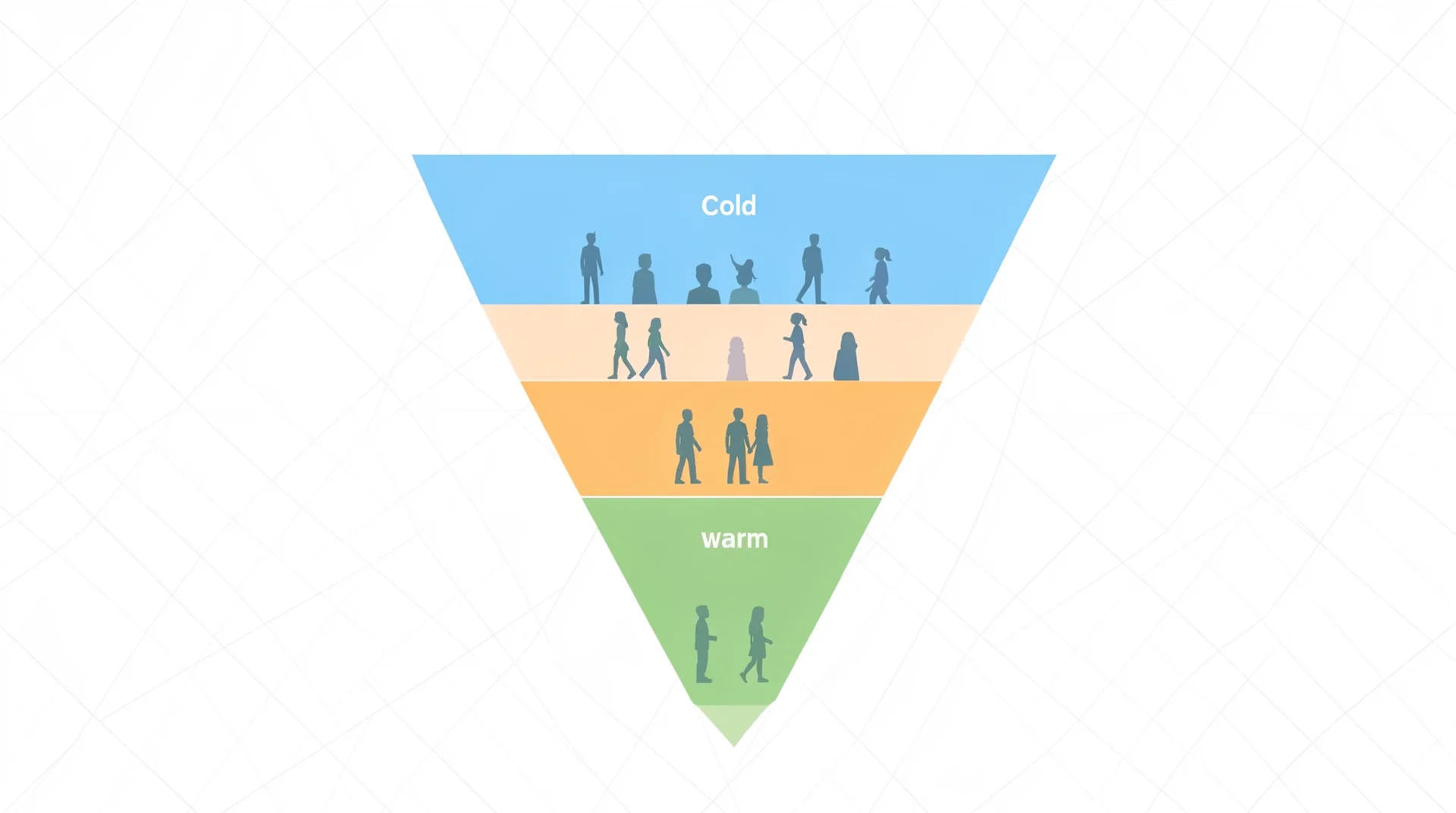
Cold = education. Warm = proof. Hot = offer. Match message to moment.
Segmentation by Funnel Stage
Match message to moment
Top (Cold)
Broad or lightly filtered
Problem awareness, category education, product intrigue
Introduce and capture attention
Middle (Warm)
Video viewers, site visitors, engaged users
Objections, comparisons, trust, social proof
Build confidence
Bottom (Hot)
Cart abandoners, repeat visitors, branded searchers
Urgency, risk reversal, direct CTA
Close the sale
Real Examples
Three businesses, three segmentation strategies
Local Dentist
$1,500/monthSegment by service intent + geography. 80-90% Google Search on emergency/high-intent keywords, 10-20% Meta retargeting if site traffic exists.
| Segment | Intent | CPC | Priority |
|---|---|---|---|
| Emergency | Highest | $8-20 | 1st |
| Restorative | High | $7-15 | 2nd |
| General | Medium | $3-8 | 3rd |
| Cosmetic | Browsing | $5-12 | Budget-dependent |
- Target whole city + 25 miles
- All traffic to homepage
- One campaign, all services
- No negative keywords
- Tight radius, real drive times
- Landing pages per service
- Separate campaigns by intent
- Negative keywords from day 1
SaaS Tool ($29/seat)
$3,000/monthSegment by use case + switching moment. "Current tool raised prices" or "team outgrew spreadsheets" are far stronger segments than "small business owners."
- Tool raised prices
- Outgrew spreadsheets
- New ops manager hired
- Lost project to missed deadlines
- Consolidating tools to cut spend
E-Commerce Candles ($35-65 AOV)
$2,000/monthSegment by creative angle, not audience settings. The best segmentation for lower-AOV e-commerce comes from how you frame the product.
Unit economics: At $35-65 AOV with $20 COGS+shipping, gross margin is $15-45. Cold prospecting CAC runs $20-40+. Single-purchase economics may be negative. Profitability requires repeat purchases, bundles, or subscriptions.
From No Data to Optimized
The five-stage progression
Start with platform-native intent or broad behavioral targeting. 2-4 seed audiences max.
Install pixel + server-side events. Connect CRM. Upload customer lists. Define conversions correctly.
Analyze actual converters by service, landing page, search query, geography, device, and creative angle.
Which audiences produce booked appointments, qualified demos, repeat purchases — not just clicks?
100+ conversions/month unlocks value-based audiences, Smart Bidding, and recency-split retargeting.
The mature version of segmentation is not handcrafted audience taxonomy. It's first-party data + conversion quality + creative mapped to buying moments.
Bottom Line
Audience segmentation is no longer about narrowing the audience. It's about identifying buying context, then letting creative and platform signals do the sorting. Start simpler than you think. Segment by intent, use case, urgency, and economics. Exclude aggressively. Match creative to funnel stage. The people who win tell the platform, with clean data, "find me more of this exact kind of buyer."